

“Most media businesses do not struggle because demand is lacking. They struggle because growth eventually collides with operational complexity.”
-Satish Thiagarajan
Today’s advertisers expect 4 basic things:- Faster campaign launches
- Greater transparency
- Continuous optimisation
- Seamless execution across an expanding mix of inventory.
Yet many retail media businesses still rely on processes designed for a different era - one where campaigns were shorter and operational pressure was easier to manage. They fail to realise that what worked when managing dozens of campaigns often begins to break when managing hundreds. More importantly, it creates a dangerous illusion of scale.
Revenue grows, and new opportunities emerge. But behind the scenes, your teams will be spending more time coordinating workflows and navigating disconnected systems. Growth starts generating friction instead of momentum.
This raises a fundamental question:
What separates retail media businesses that scale revenue from those that scale complexity?
To answer this question, let us understand three realities that are shaping the next generation of retail media networks.

Reality 1: Inventory Ownership Alone No Longer Wins
Advertisers can access more channels than ever before. What increasingly differentiates one retail media network from another is how efficiently it can move from opportunity to activation. In other words, growth is becoming less about what inventory you have and more about how effectively you operate it.
This shift is pushing many retail media companies we know to adopt capabilities that were once considered back-office functions but are now strategic growth drivers:
- Yield management: To help maximise the value of every available placement.
- Forecasting: To improve planning and revenue predictability.
- Workflow automation: To reduce operational friction and accelerate campaign delivery.
- Revenue intelligence: To provide the visibility needed to make faster decisions.
Reality 2: The New KPI Isn't Fill Rate. It's Revenue Velocity.
For years, retail media businesses have focused on filling more inventory and generating more revenue. It is a simple equation that has guided commercial teams across publishing and advertising for decades. But in an always-on retail media environment, fill rate only tells part of the story. Two retail media businesses can achieve similar inventory utilisation and deliver very different revenue outcomes. The difference often comes down to how quickly they can convert demand into revenue.
Consider what happens after an advertiser expresses interest.
- Proposals need to be created.
- Pricing may require approval.
- Campaigns must be configured, launched, monitored, and ultimately billed.
Every step introduces the possibility of delay. An advertiser ready to activate today may end up waiting days or weeks for execution. Revenue is not lost because demand is absent. It is lost because operational processes cannot keep pace with opportunity.
The most forward-thinking publishers are therefore measuring more than inventory performance. They are measuring the speed of the entire revenue journey:
- Time-to-proposal
- Time-to-approval
- Time-to-launch
- Time-to-billing
Each metric reveals where growth is being constrained. More importantly, it highlights where operational improvements can unlock additional revenue without requiring additional inventory.
Reality 3: Advertiser Experience Is Becoming the New Battleground
The logic was always simple - If you had access to valuable audiences and enough inventory to meet demand, advertisers had compelling reasons to work with you. But today, that logic no longer holds good. Similar audiences can often be reached across multiple networks, and comparable advertising formats are increasingly available throughout the market.
As a result, the experience of working with a retail media business is becoming a powerful differentiator. Advertisers increasingly value speed and ease of execution. They want proposals delivered quickly and confidence that issues will be resolved efficiently.
Every operational friction point becomes part of the advertiser experience. A slow approval process or delayed campaign launch is no longer just an internal inefficiency. It is a customer experience problem. The publishers that win the next phase of retail media growth will offer a better experience for advertisers at every stage of the revenue journey.
3 Critical Elements of Always-On Retail Media Engine
The most successful retail media businesses are building self-driving revenue engines supported by three foundational elements: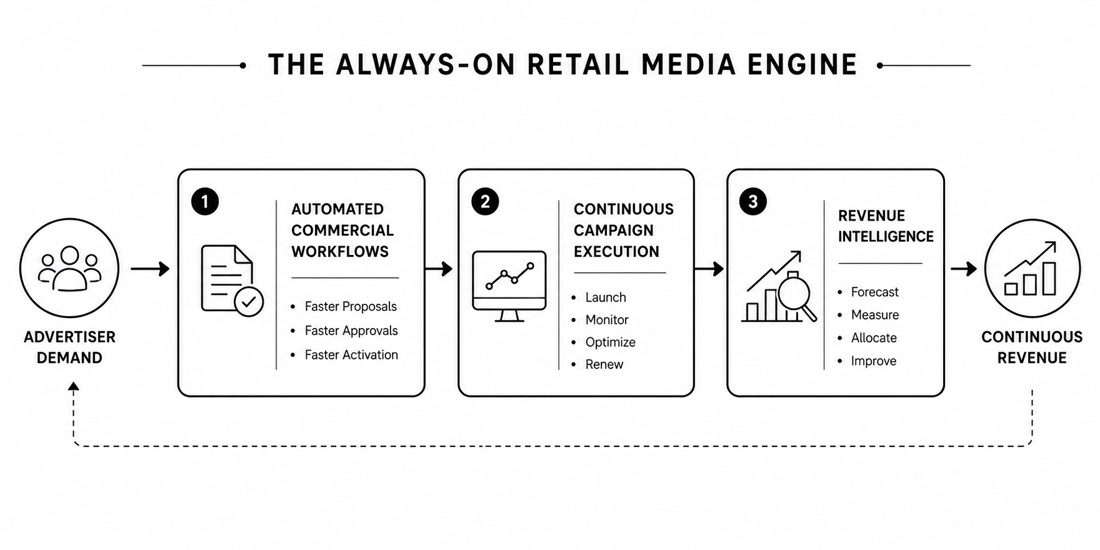
Element 1: Automated Commercial Workflows
Growth often exposes operational inefficiencies that remain hidden at smaller scales. Manual proposal creation, approval chains, contract management, and order processing may seem manageable individually, but collectively they create friction throughout the revenue cycle.
Automation removes these bottlenecks by standardising and accelerating the path from opportunity to activation. Proposals can be generated faster. Approvals move more efficiently. Sales and operations teams work from shared workflows rather than disconnected processes. The result is not simply improved productivity. It is a faster revenue operation that improves both internal efficiency and advertiser experience.
Element 2: Continuous Campaign Execution
Securing a campaign is only the beginning of the revenue journey. Long-term growth depends on how effectively campaigns are launched, monitored, optimised, and renewed. In an always-on environment, advertisers increasingly expect responsiveness throughout the campaign lifecycle rather than periodic performance reviews.
Organisations that rely heavily on manual execution often struggle to maintain consistency as campaign volumes grow. Continuous execution models combine real-time visibility and streamlined operational processes to reduce delays and surface optimisation opportunities earlier. This allows your teams to spend less time managing tasks and more time improving outcomes for advertisers.
Element 3: Revenue Intelligence
As your media businesses scale, decision-making becomes increasingly dependent on visibility. Without a clear understanding of your inventory performance, advertiser behavior, forecasting accuracy, and operational efficiency, you might find yourselves reacting to problems rather than anticipating them.
Revenue intelligence transforms operational and commercial data into actionable insights. You can gain visibility into revenue trends, utilisation rates, campaign performance, and future demand. Instead of relying on historical reporting alone, you can identify opportunities, address risks, and allocate resources with greater confidence. In an increasingly competitive market, the ability to make faster and more informed decisions becomes a strategic advantage in itself.
Technology Is Becoming the Foundation of Always-On Retail Media
There was a time when operational challenges could be solved by adding more people. More coordinators. More account managers. More operations specialists. But always-on retail media changes the equation. As your campaign volumes grow, inventory expands across channels, and advertisers demand faster execution, scaling through headcount alone quickly becomes unsustainable.
This is why technology is increasingly becoming the foundation of modern retail media operations. The challenge is no longer simply managing campaigns. It is orchestrating an entire revenue lifecycle that spans inventory management, advertiser onboarding, proposal generation, approvals, campaign execution, billing, forecasting, and performance reporting. When these functions operate in disconnected systems, friction becomes inevitable. When they operate on a unified platform, you gain the visibility and intelligence needed to scale efficiently.
Platforms such as Salesforce Media Cloud are helping retail media businesses build this foundation. By bringing sales, operations, inventory, workflows, advertiser relationships, and revenue intelligence into a connected ecosystem, Media Cloud supports you in moving faster while maintaining operational control. Instead of reacting to operational bottlenecks, you can create processes that support continuous revenue generation by design. In an always-on environment, technology is no longer a support tool. It is part of the operating model itself.
Turn Strategy Into Execution with Brysa
Most retail media businesses understand the need for automation and revenue intelligence. The challenge is rarely awareness. The challenge is execution.
Building an always-on retail media operation requires more than implementing new technology. It requires aligning processes, data models, workflows, reporting structures, and user experiences around a common revenue strategy. This is where many transformation initiatives stall.
At Brysa, we help retail media businesses like yours bridge that gap. As a Salesforce consulting partner with deep expertise in media operations, we help you design and implement the systems required to support continuous revenue growth. Whether it is streamlining commercial workflows or maximising the value of Salesforce Media Cloud, our focus is simple: helping you create operating models that scale revenue without scaling complexity.
If you're looking to build an always-on retail media operation powered by Salesforce Media Cloud, Brysa can help. Contact our team now.