

For years, ad operations have been treated like the backstage crew of growth marketing. Necessary, but largely invisible. It was viewed as a cost centre responsible for trafficking campaigns and fixing reporting issues. But that mindset has changed. Today, campaign performance depends just as much on operational agility as it does on creative strategy. The difference between campaigns that scale profitably and those that waste budget often comes down to how quickly your teams can launch and optimise campaigns. In this guide, we’ll help you reimagine your AdOps to maximise marketing ROI and unlock greater value from every campaign.
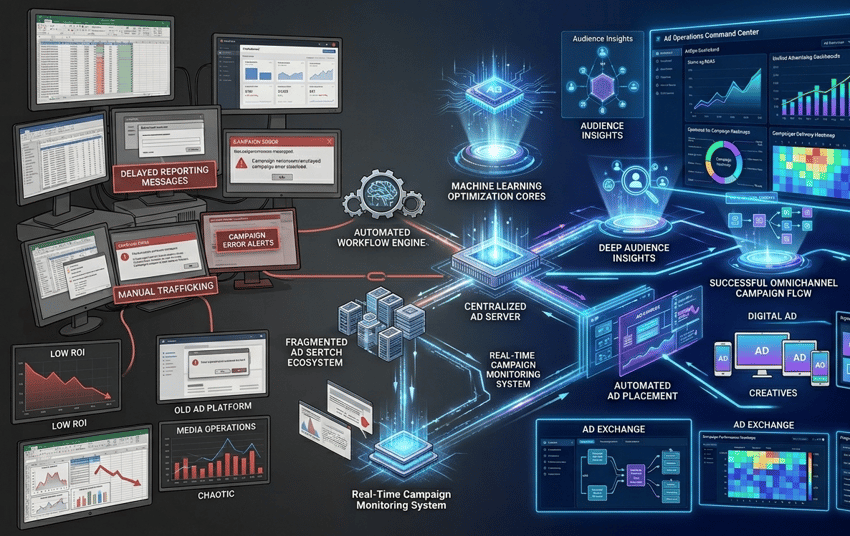
Why is AdOps Traditionally Seen as a Cost Centre?
Traditionally, AdOps has been viewed as a cost centre because its primary responsibilities were largely operational and support-driven. It was never revenue-focused. A typical AdOps team was expected only to:
- Manage campaign trafficking
- Monitor ad delivery
- Resolve technical issues
- Generate reports
- Ensure campaigns run without errors.
Since these functions operated behind the scenes and did not directly generate revenue in a visible way, businesses often categorised AdOps as an overhead expense. It was a necessary function to keep marketing operations functioning smoothly.
Another reason AdOps earned this unique perception is that much of the work was manual and reactive in nature. Teams spent significant time fixing discrepancies and troubleshooting performance issues. They seldom contributed to performance marketing strategies. Success was often measured by operational efficiency and error reduction rather than business impact or ROI.
Why the Traditional AdOps Model Is Failing Modern Marketing?
Short answer - the traditional AdOps model was always built for a much simpler marketing landscape. Long answer - Back then, campaigns ran on fewer channels and customer journeys were easier to track. But modern marketing operates in real time across multiple platforms. In such an environment, an “execution-only AdOps function” no longer cuts it. Let us understand more in detail the different factors that led to the failure of traditional AdOps model: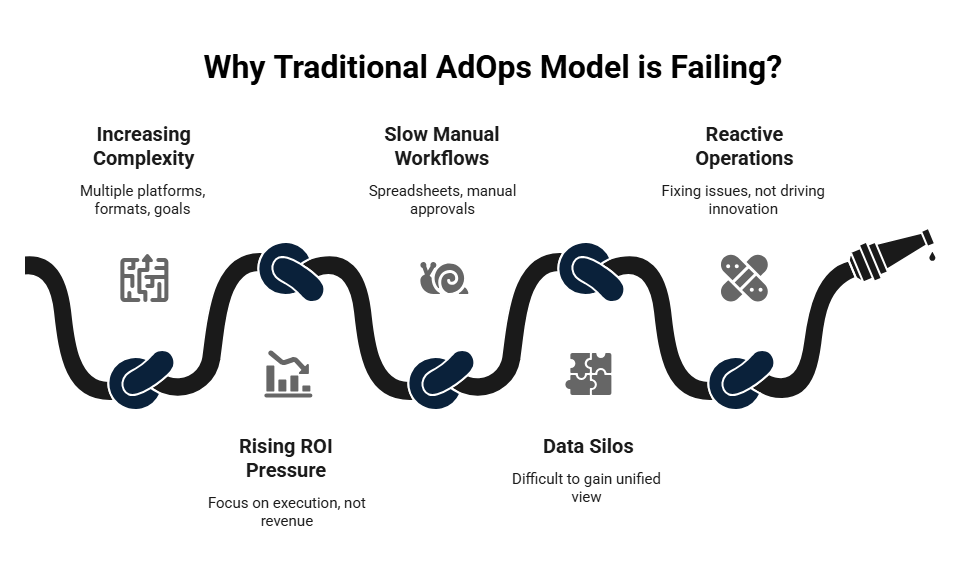 1. Increasing Complexity Across Channels
Modern marketers manage campaigns across search, social media, programmatic advertising, email, mobile apps, and more. Each platform has different formats and goals. They have unique targeting capabilities and reporting systems. Traditional AdOps workflows often struggle to handle this complexity efficiently. This invariably leads to delays and operational bottlenecks.
2. Rising Pressure to Prove Marketing ROI
Today’s leadership teams expect marketing to deliver measurable business outcomes. They don’t want just impressions and clicks. Traditional AdOps teams were primarily focused on campaign execution rather than revenue impact. This makes it difficult for businesses to connect operational performance with profitability and growth.
3. Slow and Manual Workflows
Many traditional AdOps processes still rely heavily on spreadsheets and manual approvals. There are repetitive campaign setup tasks and disconnected communication between teams. These slow workflows reduce campaign agility and prevent your marketers from responding quickly to changing market conditions and performance trends.
4. Data Silos and Limited Visibility
Campaign data is often spread across multiple platforms and tools. This makes it difficult to gain a unified view of performance. Without centralised visibility, your teams will struggle to optimise campaigns effectively and make smarter data-driven decisions.
5. Reactive Operations Instead of Strategic Contribution
Traditional AdOps models position your teams as reactive support functions focused on troubleshooting and execution. As a result, your teams spend more time fixing issues than driving innovation and long-term marketing performance improvements.
How to Transform AdOps From Being a Mere Cost Centre to a Profit Engine?
Transforming AdOps into a profit engine requires more than just adopting new tools. It demands a shift in mindset and priorities. Instead of treating AdOps as a backend execution function, you need to consider it as a strategic driver of efficiency and revenue growth. Here are some key strategies you can adopt to make that transition successfully.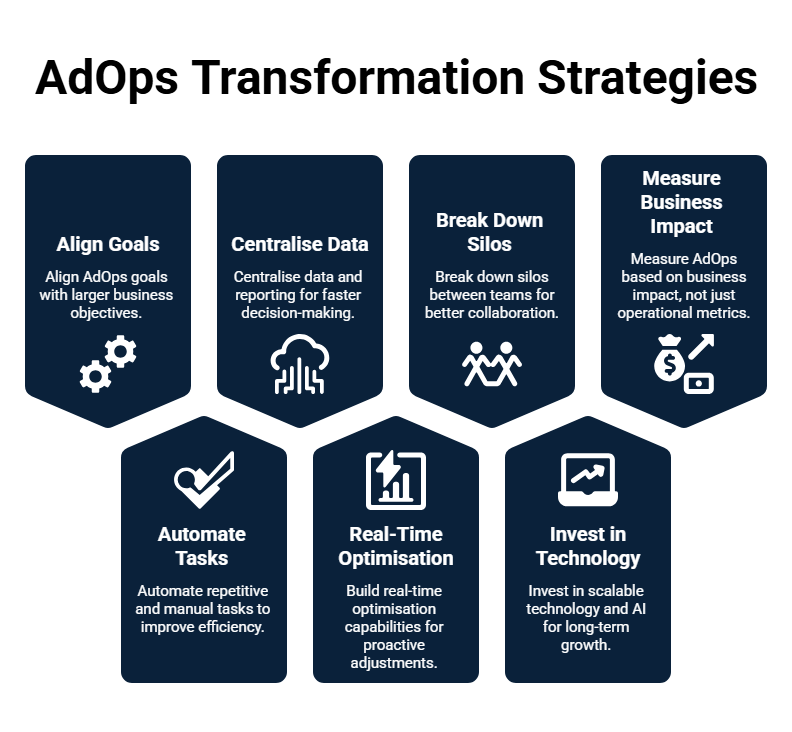 1. Align AdOps Goals With Business Outcomes
The first step is to move beyond operational KPIs alone. Your AdOps teams should be aligned with larger business objectives such as revenue growth, customer acquisition, campaign profitability, and retention. When your team understands how their work impacts business performance, they can make faster and smarter optimisation decisions.
2. Automate Repetitive and Manual Tasks
Manual workflows consume time and create unnecessary errors. Automating campaign setup, reporting, tagging, approvals, and optimisation processes helps your team operate more efficiently. It also frees up their time for more strategic initiatives that improve campaign performance and ROI.
3. Centralise Data and Reporting
Disconnected systems create fragmented insights and slow decision-making. You should invest in centralised dashboards and unified reporting systems that bring campaign, audience, and performance data together. A single source of truth enables faster optimisation and better strategic planning.
4. Build Real-Time Optimisation Capabilities
Modern marketing moves quickly. And waiting days for performance insights is no longer practical. Your AdOps teams should have access to real-time analytics and optimisation tools that allow them to adjust budgets, creatives, targeting, and bidding strategies proactively before campaigns underperform.
5. Break Down Silos Between Teams
AdOps cannot function effectively in isolation. Your marketing, sales, analytics, creative, and operations teams need to collaborate closely to improve campaign execution and customer experiences. Shared goals and integrated workflows create better alignment and stronger marketing outcomes.
6. Invest in Scalable Technology and AI
As your campaign complexity increases, your legacy systems can become a major limitation. You should adopt scalable AdTech solutions and AI-powered optimisation platforms that improve operational efficiency and support long-term growth without increasing overhead costs. Platforms like Salesforce Media Cloud can help unify campaign data, streamline advertising workflows, enable real-time insights, and deliver more personalised customer experiences at scale.
7. Measure AdOps Based on Business Impact
To fully reposition AdOps as a profit engine, you need to change how success is measured. Instead of focusing only on operational metrics like delivery accuracy or turnaround time, you should evaluate AdOps based on campaign profitability, ROAS, customer acquisition efficiency, and contribution to revenue growth.
How a Transformed AdOps Will Drive Marketing ROI?
Instead of operating reactively, a fully transformed AdOps will help you launch smarter campaigns faster and continuously improve performance across every marketing channel. Here are some changes you will experience in your marketing function:
- Faster Campaign Execution: Automated workflows and streamlined approvals will help your teams launch campaigns quickly and respond faster to market changes.
- Improved Budget Efficiency: Real-time optimisation will help you allocate budgets more effectively and reduce wasted ad spend.
- Better Audience Targeting: Unified customer data will support personalised and accurate targeting. It will lead to higher engagement and conversions.
- Reduced Operational Errors: Automation will minimise manual mistakes in campaign setup and trafficking. This will improve overall campaign performance.
- Stronger Cross-Channel Visibility: Integrated systems will provide a complete view of performance across platforms. This will help your marketing team optimise campaigns holistically.
- Enhanced Customer Experiences: Better coordination between marketing operations and customer data. This will allow you to deliver more seamless experiences.
- Improved Scalability: Modern AdOps systems will allow you to scale campaigns and operations efficiently without significantly increasing operational overhead.
The Role of AI in Modern Ad Operations
AI-powered AdOps solutions like Media Cloud will transform your AdOps function from an execution-heavy function into a data-driven growth engine. All the repetitive tasks, such as campaign setup, reporting, bid adjustments, audience segmentation, and performance monitoring, will be automated. This will completely eliminate operational inefficiencies and help you operate at scale without significantly increasing operational overhead.
Beyond automation, such platforms will play a critical role in improving decision-making and campaign performance. By analysing large volumes of customer and campaign data in real time, it will help identify trends, predict audience behaviour, optimise targeting, and recommend budget allocations far faster than manual analysis ever could. As a result, you will be able to deliver more personalised customer experiences and maximise ROI across increasingly complex advertising ecosystems in a short time.
How Can Brysa Help?
As advertising ecosystems become more and more complex, you need more than just technology. You need the right strategy and implementation expertise to fully unlock the value of modern AdOps. This is where Brysa can help. We transform your traditional advertising operations into ROI-driven growth engines. With deep expertise in MediaOps and the Salesforce ecosystem, we help streamline your workflows and build intelligent operational frameworks that improve marketing ROI and performance.
From implementing Salesforce Media Cloud solutions to automating campaign operations and enabling real-time analytics, we work closely with you to modernise your AdOps infrastructure. Whether you are looking to modernize legacy AdOps workflows or maximise marketing ROI with Salesforce Media Cloud, we can help you build a smarter MediaOps strategy. Contact our team today to explore how we can help.