

Ad operations is often portrayed as a highly automated machine powered by AI and programmatic buying.
Yet behind every seamless campaign launch is a Slack thread with 47 messages, three spreadsheets named "Final_v8_Updated," and someone manually fixing a trafficking error five minutes before go-live.
If this sounds familiar to you, then your ad ops isn't broken. It's burdened. And until you understand why manual work persists in your ad operations, you’ll continue treating symptoms instead of solving the problem.

The Automation Paradox
For an industry built largely on automation, advertising remains surprisingly manual. Every new wave of AdTech promises greater efficiency. Yet ad operations teams often find themselves managing more complexity, not less. What was once a relatively simple ecosystem of publishers and ad servers has evolved into an interconnected web of:
- Demand-side platforms (DSPs)
- Supply-side platforms (SSPs)
- Ad servers
- Data clean rooms
- Measurement tools
- Retail media networks
- Privacy and consent platforms.
Each solution addresses a specific challenge (targeting, measurement, compliance...), but together they create a ‘patchwork setup’ that requires constant coordination.
This is the automation paradox!
“When advertising tech gets more and more sophisticated, the human effort needed to connect systems and manage exceptions continues to grow.”
-Satish ThiagarajanWhile ad tech has successfully automated transactions such as bidding and audience activation, it has done far less to automate the workflows that span multiple platforms. Activities like reconciling reports, translating inconsistent taxonomies, troubleshooting integrations, and ensuring campaigns run as intended are still largely manual work. The result is a simple but often overlooked reality: ad tech has automated transactions, but not workflows.
The Five Manual Tasks in Ad Ops That Refuse to Die
Despite decades of innovation, some ad operations tasks remain stubbornly resistant to automation. Every ad ops professional knows these tasks well. They're the invisible work that keeps campaigns running but rarely appears on a project plan: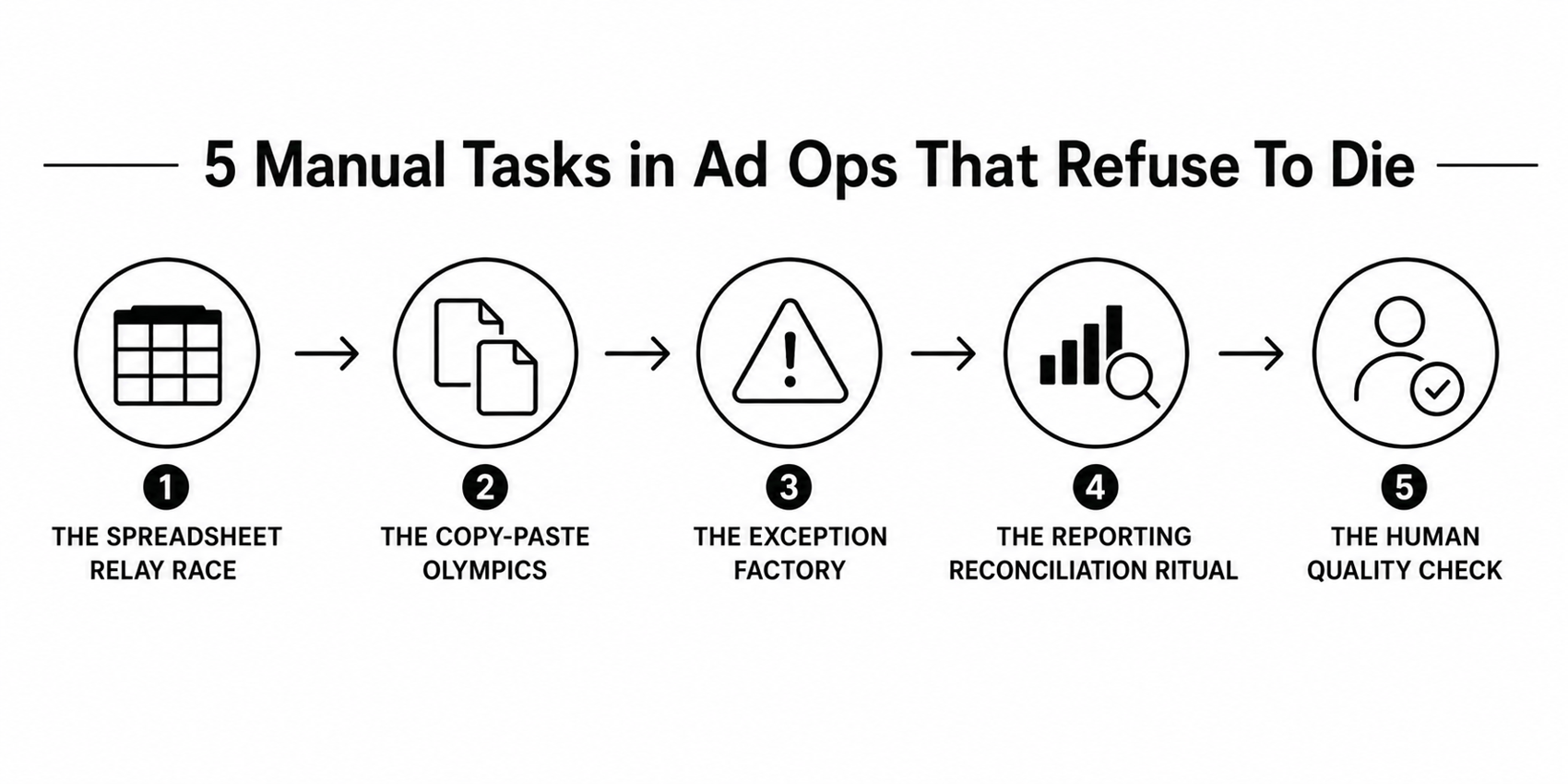
1. The Spreadsheet Relay Race
Campaign data still moves across systems that were never designed to speak the same language. Teams export, reformat, enrich, and re-upload information simply to maintain alignment across platforms.
2. The Copy-Paste Olympics
Trafficking details, creative versions, targeting parameters, and pacing adjustments continue to be manually transferred between tools. It creates opportunities for errors at every handoff.
3. The Exception Factory
No two campaigns are exactly alike. Custom audience requirements, publisher-specific rules, unique client requests, and evolving compliance standards create a constant flow of exceptions that AI workflow automation struggles to handle.
4. The Reporting Reconciliation Ritual
Ad ops teams often spend more time aligning metrics than interpreting them. When different platforms define impressions, conversions, or attribution differently, reporting becomes an exercise in negotiation rather than analysis.
5. The Human Quality Check
Automation can launch a campaign. But humans are made to ensure it launches correctly. Final reviews, validation checks, and troubleshooting remain essential because even the most sophisticated systems cannot fully replicate context and accountability.
These tasks persist because they exist in the spaces between platforms. The gaps where workflows break down, and human coordination takes over.
The Cost of "Just Five More Minutes"
In ad operations, inefficiency rarely arrives as a major disruption. It shows up as a series of seemingly harmless requests:
One more spreadsheet update.
One more reporting adjustment.
One more manual check before launch.
Five minutes here, ten minutes there. Individually, these tasks feel insignificant. Collectively, they become a hidden tax on productivity that compounds across campaigns and quarters.
Manual work doesn't just slow processes down. It creates a ripple effect across the entire operation.
- Campaign launches take longer → Increases the risk of missed opportunities.
- Repetitive tasks introduce more room for human error → Leads to rework and delayed campaign optimisation.
- Teams spend valuable time reconciling reports → No time left to uncover insights
- Constant pressure to manage exceptions→ Contributes to employee burnout
Every hour spent moving data between systems is an hour not spent improving performance or strengthening client relationships. The highest cost of manual work isn't operational inefficiency. It's the lost opportunity.
Start Designing Intelligent Operations: Key Steps
The answer to ad ops efficiency is a shift in mindset: from automating individual tasks to designing intelligent operations. Here are the steps to design them:
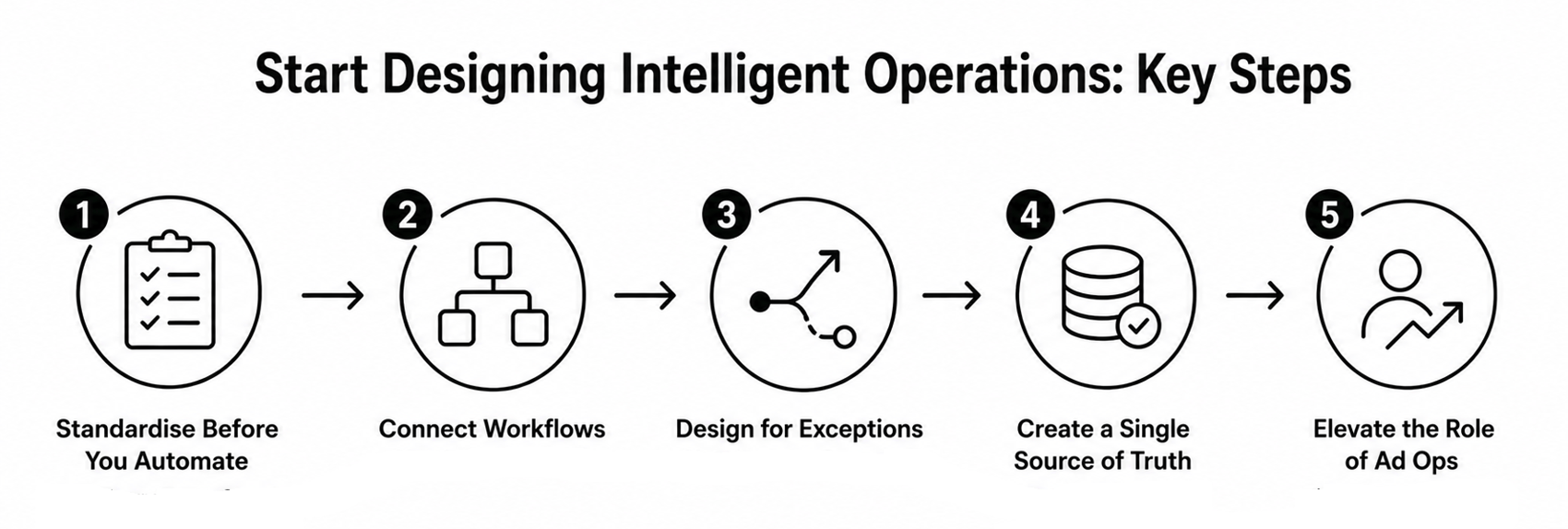
Step 1: Standardise Before You Automate (Not Every Team Should Have Its Own Process)
Automation is only as effective as the process behind it. If naming conventions, campaign setups, approval workflows, and reporting definitions vary across teams, automation will simply scale inefficiencies. Establishing clear standards creates consistency and provides a strong foundation for successful automation initiatives.
Step 2: Connect Workflows (Not Just Platforms)
Most ad tech stacks already exchange data. Yet teams still rely on spreadsheets and chat messages to keep campaigns moving. The goal should be to connect the entire workflow, right from campaign intake and approvals to trafficking and reporting. This will ensure that information flows seamlessly across systems without constant human intervention.
Step 3: Design for Exceptions (Not the Ideal Scenario)
Ad operations rarely follow a predictable path. Custom audience requirements, publisher-specific rules, compliance updates, and last-minute campaign changes are the norm, not the exception. Intelligent operations account for this reality by building flexible workflows that can adapt to changing requirements while clearly defining when human judgment is needed.
Step 4: Create a Single Source of Truth (Not Spreadsheet Diplomacy)
When campaign data is scattered across multiple platforms, your teams will spend more time validating information than acting on it. A centralised view of campaign status, performance metrics, and workflow data ensures everyone works from the same information, reducing reconciliation efforts and accelerating decision-making.
Step 5: Elevate the Role of Ad Ops (Not More Manual Execution)
The future of ad operations is all about enabling smarter decisions. As repetitive tasks become automated, your ad ops teams can shift their focus toward workflow optimisation and performance strategy. The most successful teams won't be measured by how many campaigns they launch, but by how effectively they design systems that scale.
Closing the Gap Between Strategy and Execution
Designing intelligent operations is one thing. Implementing them across an entire ad tech ecosystem is another. Most media organisations already have the technology they need. The challenge lies in standardising workflows, creating a single source of truth, and designing for exceptions. They require more than new tools. They require a deep understanding of how ad operations function in the real world. Enter Brysa.
We help media organisations transform ad operations from a collection of manual tasks into an intelligent operating model. With extensive expertise in media operations and Salesforce, we understand the realities behind the spreadsheets, reporting discrepancies, workflow bottlenecks, and campaign exceptions that slow teams down.
Rather than adding another layer of technology, we focus on making your existing ecosystem work better. Our goal - help you achieve faster campaign execution, better visibility across operations, and more time for teams to focus on optimisation and growth. Ready to join hands with us? Contact us now.